Welcome to the Free Press blog! We post several times a week on everything from Internet access to free speech to media mergers, so check back often to see what we’re up to.
In last night’s State
of the Union address, President Obama called for a
“renewal of American values.” However, over the course of his wide-ranging
speech, he made no mention of one core value: the fundamental role of the free
press in America.
This absence was highlighted this morning when Reporters Without
Borders released its 2011–2012 global Press
Freedom Index. After months of journalist arrests
and press suppression at Occupy Wall Street-inspired protests, the United
States has plummeted in the rankings.
People inside the D.C. bubble often tell stories about lavish
fundraisers and the use of campaign cash to shore up votes in Congress.
Conspiracy theories about who uses their PAC money, or direct contributions, to
bend the ear of powerful committee chairmen and party leaders circulate throughout
the capital faster than the Metro.
Still, the stories are usually hard to substantiate, and
publicly members of Congress and their staffs are quick to deny that money has
any influence at all. Rarely is the systemic corporate capture of Washington,
D.C., on display in such a transparent and ugly way as it was last week.
In the media reform world, we often say we’re fighting for
“better” media. Of course, “better” is the sort of word that begs comparison:
better than what? If we’re to demand more of our local broadcasters, we need to
know what’s wrong with the status quo.
Broadcasters use the public airwaves free of charge, and in return
are supposed to provide programming that fulfills the news and information
needs of communities. The Federal Communications Commission requires
broadcasters to keep public files detailing exactly how they serve local needs.
But these records are generally kept in file cabinets at local TV stations and
are not easily accessible. So the pressure is on for broadcasters to put these
files online in a publicly searchable database.
Under
the leadership of our friends at New Mexico’s Media Literacy Project, ninth
graders Jack Folkner, Martin Jencka and Jay Jewell-Roth created a video about
the recently shelved Stop Online Piracy Act (SOPA).
Yesterday was unbelievable. In an
unprecedented show of strength, millions of Internet users rose up against the House’s
Stop Online Piracy Act and the Senate’s Protect IP Act, with Wikipedia, reddit,
Boing Boing, SavetheInternet.com and thousands of other sites going black to join in the protest (even Google hid its logo behind a
black bar for the day). Millions sent letters to Congress, and tens of thousands
picked up the phone to urge their senators to vote “no” on PIPA, which is
scheduled for a Jan. 24 vote.
Our local media outlets are being
stripped for parts. Aided by decades of bad policymaking, the large companies that control most of the broadcast outlets across the
country are laying off local DJs, shuttering local newsrooms and inching ever
closer toward creating monopolies in local marketplaces. The more media outlets
consolidate, the more our diverse local media is being replaced by faceless,
automated infotainment. If it’s true that the media influences and shapes our
culture, then we’re headed down a path to uniformity, where cheap centralized
content replaces diverse local voices and quality programming.
Tomorrow you might be wondering who turned
out the lights. Don’t worry — it will simply be one of the biggest days in the
history of the open Internet.
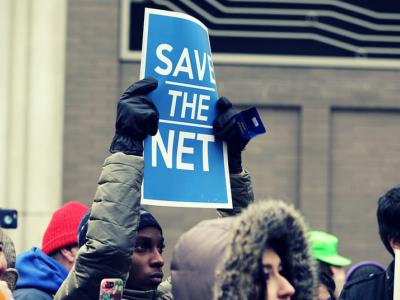
Thousands of websites — including
Wikipedia, reddit, BoingBoing, FreePress.net and SavetheInternet.com — will go dark to protest the Stop Online Piracy Act (SOPA) and Protect IP
Act (PIPA), bills in the House and Senate that could open the door to
widespread censorship online.
Earlier this week we pointed to a Media Matters for America study showing that most of
the major networks — ABC, CBS, Fox News, MSNBC and NBC — have failed to cover
opposition to the Stop Online Piracy Act (SOPA) and the Protect IP Act (PIPA).
Online piracy is definitely a problem. But
these bills would do little to solve it. They’re the latest effort in Hollywood’s
Sisyphean quest to close the open Internet — and slow down the kinds of online
innovation that threaten the old-school media masters.
The first-ever
study on mobile donors found that charitable donations made via cellphones
have jumped in recent years. The report from the Berkman Center for Internet
& Society and the Pew Research Center analyzed the “Text to Haiti” campaign
that followed the devastating 2010 earthquake.
The study shows that most text donors contributed on impulse
as news about the campaign spread via friend networks. “Three quarters of these
donors contributed using their phones on the same day they heard about the
campaign,” the study notes, “and a similar number say they typically make text
message donations without conducting much in-depth research beforehand.”